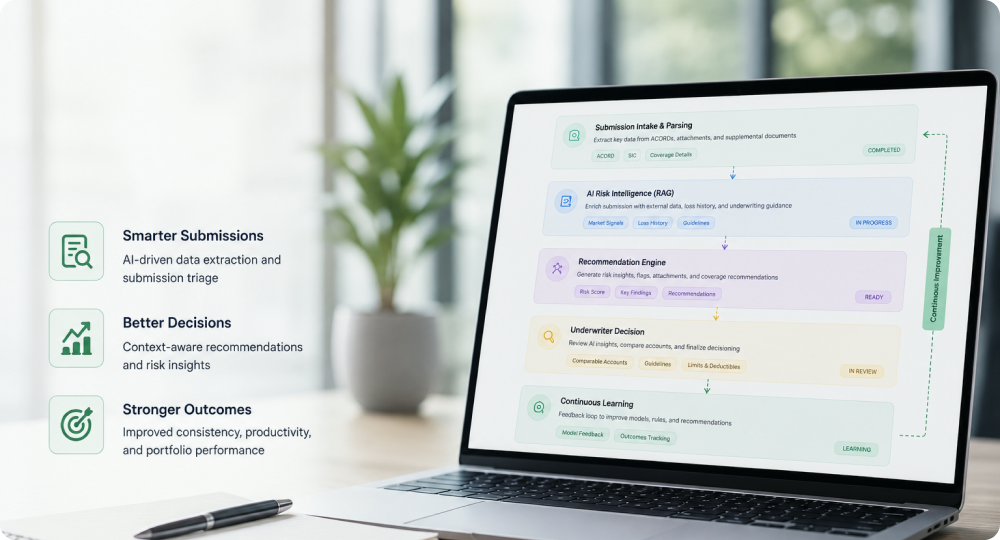
Insurance underwriting is becoming increasingly complex due to growing volumes of submission data, evolving risk profiles, regulatory requirements, and the need for faster decision-making. Underwriters often spend significant time reviewing documents, analyzing historical claims, comparing similar risks, and determining appropriate pricing and coverage recommendations.
The AI-Powered Underwriting Assistant acts as a real-time knowledge companion that augments underwriters throughout the decision-making process. Leveraging Generative AI, Retrieval-Augmented Generation (RAG), and enterprise data intelligence, the solution delivers contextual insights, risk recommendations, and scenario analysis to improve underwriting quality and consistency.
- Fragmented, unstructured information : Critical underwriting data is often fragmented across submission documents, policy administration systems, claims histories, loss runs, broker correspondence, risk engineering reports, and third-party risk intelligence sources, making it difficult for underwriters to obtain a comprehensive view of the risk.
- Inconsistent decisions : Inconsistent underwriting practices across teams can result in variations in risk assessment, coverage recommendations, and pricing decisions, impacting portfolio performance and profitability.
- Long onboarding cycles : The complexity of underwriting guidelines, risk evaluation, and coverage determination creates lengthy onboarding cycles, delaying the time required for new underwriters to achieve full productivity.
- Manual risk assessment : Underwriters spend considerable time evaluating submission data, loss runs, claims histories, and coverage requirements to accurately assess risk and determine appropriate pricing and policy terms.
- Increasing Submission volumes : As submission volumes continue to rise, underwriters face mounting pressure to process risks more efficiently without compromising the consistency and quality of underwriting decisions.
- Intelligent submission analysis : Automatically review submission documents, loss runs, claims histories, engineering reports, and supporting materials to extract key risk information, identify underwriting considerations, and accelerate risk evaluation.
- Risk Appetite Assessment : Evaluate submissions against underwriting guidelines, risk appetite frameworks, and authority limits to identify potential exceptions, escalation requirements, and compliance concerns.
- Context-aware recommendations : Assist underwriters with coverage recommendations by leveraging prior decisions, similar risk profiles, policy precedents, and established underwriting rules.
- Risk scoring and loss analysis : Analyze submissions to uncover risk indicators, historical loss trends, and exposure concentrations that could impact risk selection and underwriting profitability.
- Underwriting Benchmarking : Benchmark submissions against previously underwritten accounts with comparable risk characteristics, exposures, and loss experience to improve underwriting consistency.
- Pricing guidance : Generate data-driven pricing guidance and highlight key risk factors, loss trends, and exposure characteristics that influence premium determination.
- Explainable AI : Provide explainable underwriting recommendations by surfacing the risk factors, loss experience, underwriting guidelines, comparable accounts, and supporting evidence that drive decision outcomes.
The Assistant integrates directly into the specialty underwriting workflow as a real-time decision support layer, moving from raw submission to an evidence-backed, explainable recommendation – with the underwriter remaining the final decision-maker at every step.
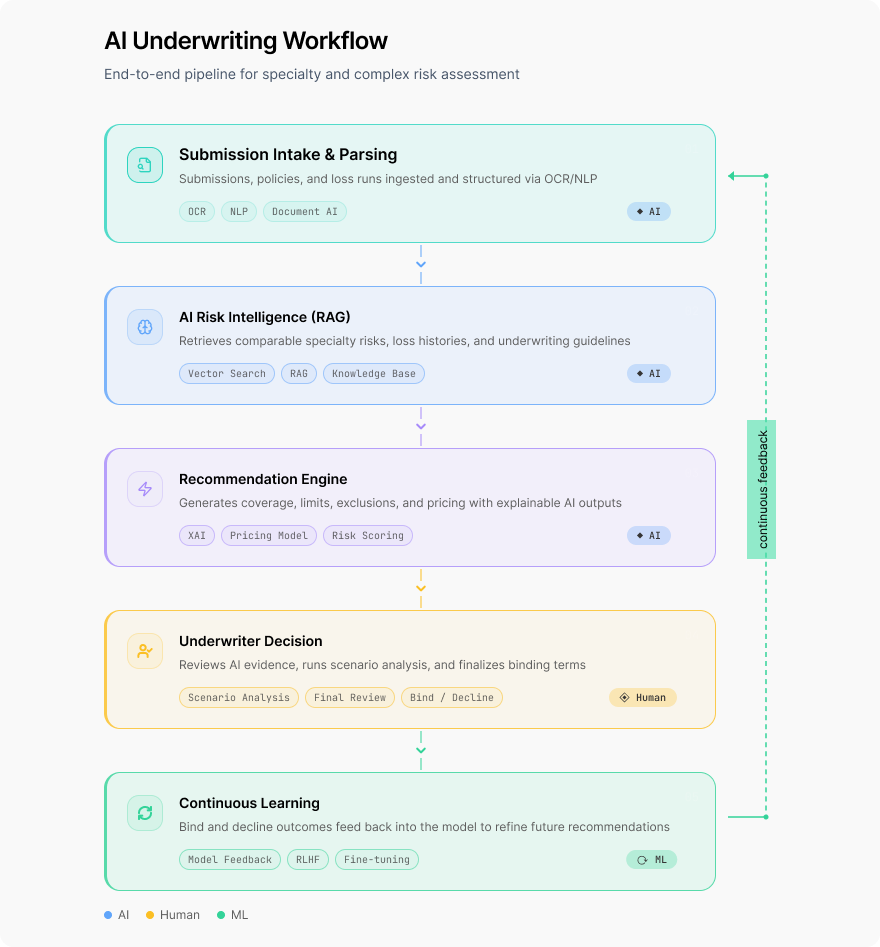
Submissions are first parsed and enriched, then matched against comparable specialty risks and underwriting guidelines through retrieval-augmented generation. The recommendation engine produces coverage, pricing, and exclusion guidance with full supporting evidence, which the underwriter reviews, stress-tests through scenario analysis, and finalizes. Bind, decline, and subsequent loss outcomes then feed back into the system, continuously sharpening recommendations for the next submission in that line of business.
-
AI-powered risk intelligence
Generates comprehensive risk assessments by combining structured policy and claims data with unstructured submission documents.
-
Real-time knowledge companion
Answers underwriting questions in context during evaluation, drawing on guidelines, precedent, and loss history.
-
Coverage recommendation engine
Suggests policy structures, exclusions, limits, and endorsements suited to the specific risk and line of business.
-
Historical loss analytics
Highlights claim trends and risk concentration areas across the specialty book.
-
Pricing decision support
Recommends premium ranges based on comparable accounts and historical portfolio performance.
-
Scenario analysis
Allows underwriters to evaluate multiple pricing and coverage configurations before binding.
-
Continuous learning
Improves recommendations over time based on underwriting outcomes and accumulated organizational knowledge.
Organizations deploying AI-assisted underwriting solutions have reported directional improvements such as :

submis submission review

consistency

onboarding time fulfillment


underwriter capacity

profitability

Specialty underwriting depends on expert judgment that cannot be replaced. The challenge is not automating underwriters-it is enabling them to make better decisions with faster access to relevant information, historical precedent, underwriting guidelines, and risk insights. The AI Underwriting Co-Pilot reduces time spent searching for information and increases time spent evaluating risk, helping insurers improve underwriting consistency, productivity, and decision quality.