
Streaming data is a common characteristic seen in modern software systems. Understanding incoming data even before it gets into an analytics store is imminent with businesses aiming for real time updates. Stream processing has wide range of applications including anomaly detection, personalized customer experience, access to real-time data visibility etc.

Streaming data is a common characteristic seen in modern software systems. Understanding incoming data even before it gets into an analytics store is imminent with businesses aiming for real time updates. Stream processing has wide range of applications including anomaly detection, personalized customer experience, access to real-time data visibility etc., In this blog, ksqlDB , a stream processing abstraction, is discussed in its capacity to build a streaming data pipeline.
For this blog, let’s consider the Bike Sharing Systems (BSS) used in major cities today. To explain BSS briefly – Docking stations are spread across the city. Each docking station has a bunch of docking slots. Bikes can be hired at docking stations and the users are charged until it’s docked back at a station slot.
The most common challenge these systems face is the Balancing problem or the Repositioning problem i.e., Docking stations are either full or empty.
Understanding mobility patterns helps BSS operators to device an optimal strategy to make the bikes available during a time of the day at a particular station. And for sudden spikes, BSS operators usually solve the asymmetric demand by repositioning bikes from top destination stations to top origin stations. There are other approaches to reposition bikes, but they are beyond the scope of this blog.
Assuming events for bikes and slots availability at each docking station are streamed as station status, ksqlDB helps in enriching the bike availability events by joining station status events (containing docks and bike availability at stations) with their corresponding docking station details like name, latitude/longitude, capacity etc., This way the events are made readily usable by OLAP stores for analytics/visualization and other downstream dependent services.
ksqlDB is a combination of the following three things
- Compute Engine – to filter, mask, transform and build/join streams of events using SQL syntax
- Runs embedded Kafka Connect connectors – to connect with a wide range of external sources and sinks
- Materialized views builder – a disk based RocksDB store for faster search and retrieval
Along with the above powers, ksqlDB can also be scaled, secured and monitored as a single unit.
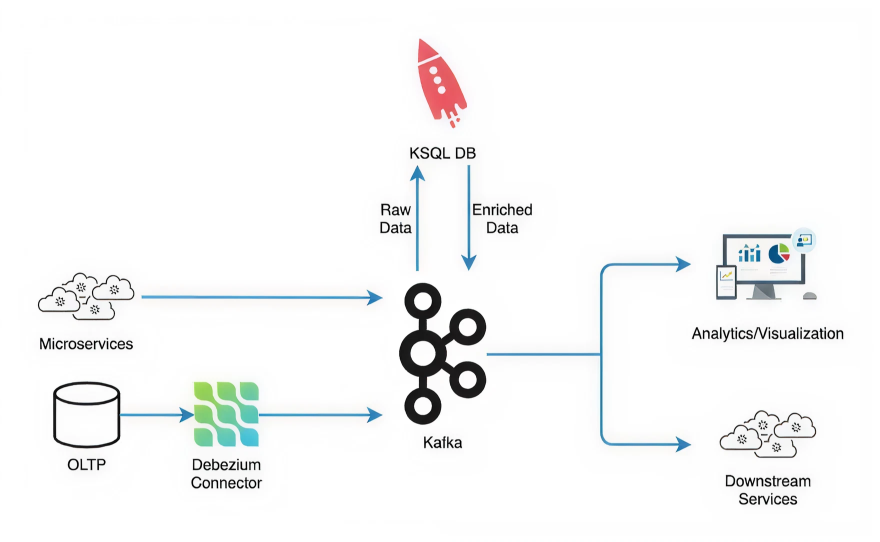
Details of docking stations rarely change and are usually maintained in an OLTP store. A CDC system like Debezium can be used to build an initial snapshot of the entire table and incremental changes as a sequence of events on a Kafka topic. ksqlDB can then build a KTable from this topic, a materialized view of the table on a disk-based DB. This can then be made available to make joins with a Kafka Stream, i.e., data-in-motion.
Schema for the station availability and station information are taken from Global Bike Feed Specification
Sample query to create KStream from station status events

Sample query to create KTable for station information events
With ksqlDB, KStreams can be created using SQL syntax that then runs as a persistent stream query on ksqlDB infrastructure. Persistent stream query is just a KStreams application under the hood. Joining a stream with a KTable by primary key produces an enriched stream of events with details from two topics merged together as below
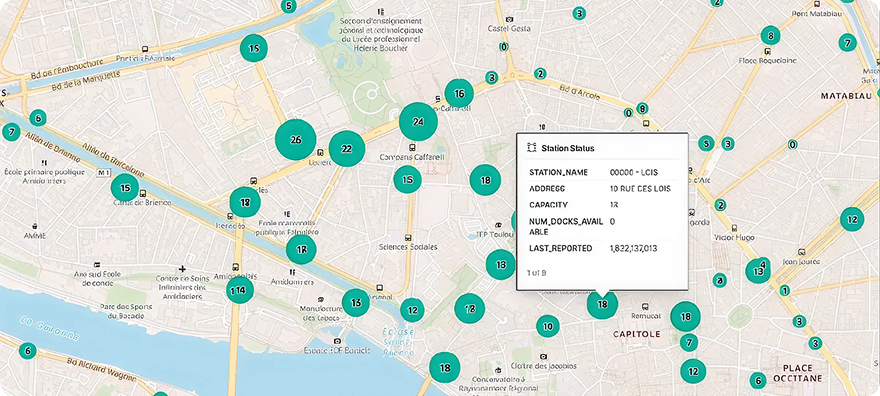
The merged data can then be sent to a store like Elasticsearch and visualized in real-time with Kibana
- Persistent Queries does all the hard work on ksqlDB layer, which otherwise would have been an application logic, with low latency as it stays closer to data
- State store to perform aggregations on a disk-based DB provides performance advantage
- Ability to run embedded Kafka Connect connectors removes the need to manage separate data integration infrastructure from compute
With the abilities to perform stateless transformations and stateful aggregations over streams, providing accessibility via SQL, it makes ksqlDB a hard component to be looked over when building a streaming data pipeline.