

AI Assistance for urban planners to support clear and evidence-based land-use planning, powered by Eartheon’s DT
Platform
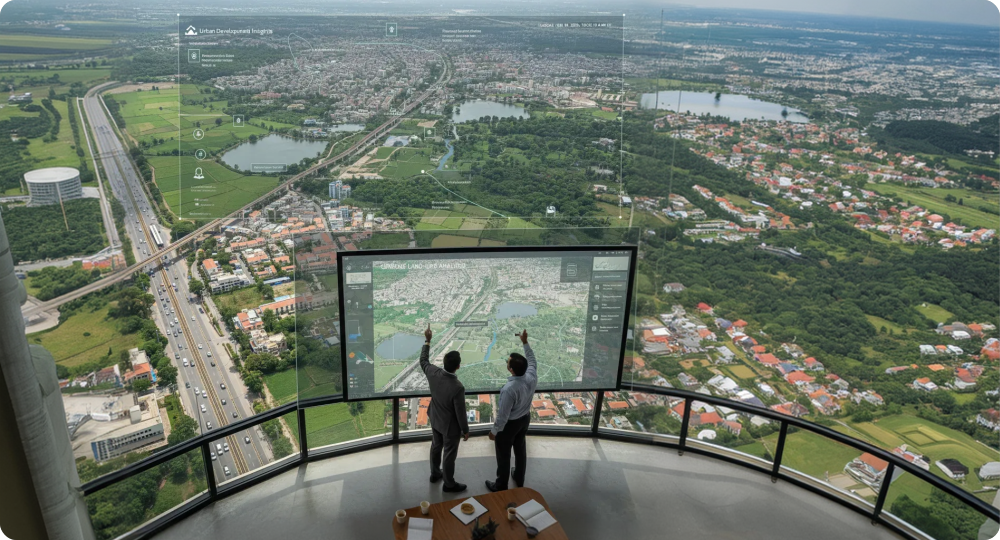
Every time we decide to build a new road, a Metro line, or an Airport – or even when we choose to plant a forest – we are making a choice that ripples through our climate, our food supply, and our future. For a long time, these choices were hard to make because no one could see the whole “puzzle” at once. To solve this, BigThinkCode and Eartheon have partnered with the Tamil Nadu State Land Use Research Board (TNSLURB) to create TiNAI – the Tamil Nadu Land Use Information System.
As a ‘Digital Twin’ of our state, TiNAI uses AI to bring decades of research into one clear picture. Inspired by the ancient Tamil concept of Aintinai, which honors the harmony between people and nature, It’s more than just a map; it’s a tool for smarter governance and a more resilient future for all of us.
We’ve made huge leaps in spatial research, but a major “disconnect” remains between data generation and policy implementation:


TINAI goes beyond just storing data; it turns that information into ‘Spatial Intelligence’ – giving planners a clear, active tool to design a better future.
Powered by Eartheon, TiNAI translates two decades of deep research into insights anyone can understand. It’s a multi-sectoral platform that bridges the gap between nine essential sectors – including Agriculture, Urban Growth, Forestry, and Disaster Management – ensuring that no matter the industry, we are all planning on the same page.
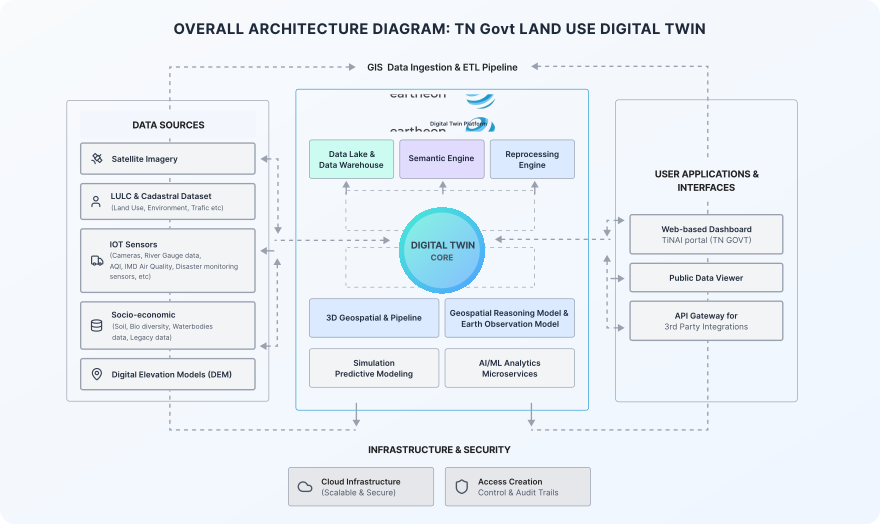
- A Unified Data Hub: The platform pulls together diverse datasets, including topographical maps, cadastral information, environmental impact assessments, socio-economic indicators, and real-time sensor data. This holistic view provides a comprehensive understanding of land characteristics and usage.
- Real-time Monitoring and Analysis: With the power of Eartheon Digital Twin, the Tamil Nadu State Planning Commission (TN SPC) can monitor land use changes in real-time, identify trends, and analyze potential impacts of various development scenarios. This proactive approach allows for timely interventions and informed decision-making.
- Predictive Modeling: The platform provides the power of advanced simulations and predictive modeling, allowing urban planners to virtually simulate the effects of new infrastructure projects. By assessing environmental risks and optimizing resource allocation in a digital environment, we can ensure every decision is sound before physical implementation begins.
- Enhanced Collaboration and Transparency: As a shared, interactive platform, the Digital Twin fosters seamless collaboration between government departments, stakeholders, and citizens.
- Sustainable Development: Ultimately, the platform empowers the TN SPC to make more informed decisions that promote sustainable land use. By providing the tools to protect natural resources, it ensures that equitable development remains a priority for the entire state.
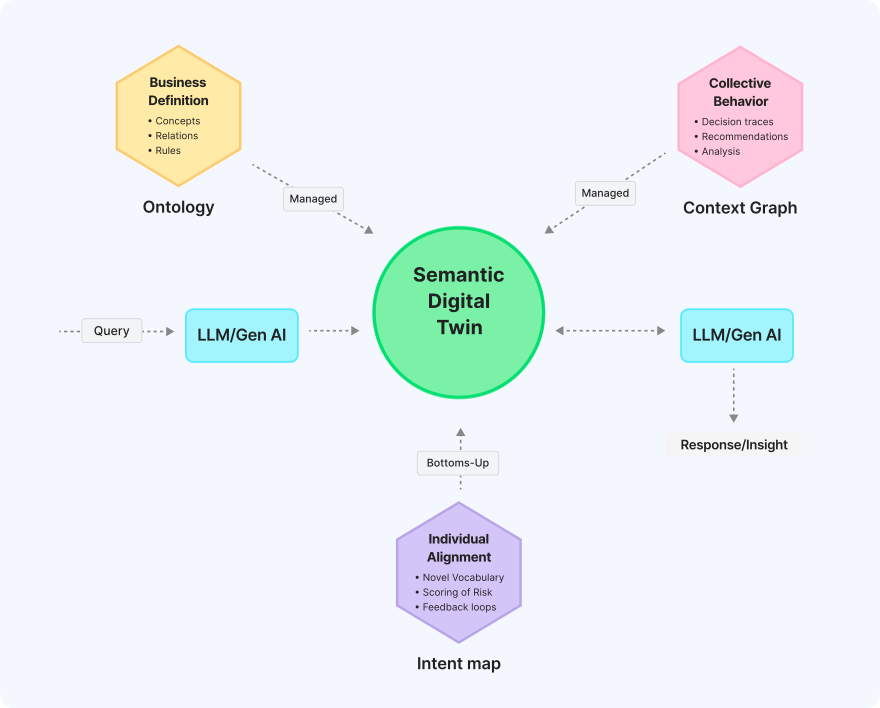
Beyond simple mapping, the TiNAI platform utilizes a Semantic Digital Twin to ensure all data is understood in context. By weaving together business definitions, collective behaviour analysis, and intent mapping, the system can provide actionable insights directly to users via a conversational AI interface.
This architecture allows for:
- Interactive Interpretation: Delivering automated visual and textual interpretations that move far beyond basic maps.
- KPI-Driven Semantics: Utilizing a synthesis of KPIs across modules to provide clear, data-backed guidance for decision-making.
- AI-Assisted Exploration: Making complex land systems accessible to non-technical users through natural language queries. This ensures easy access for non-GIS users, allowing them to interpret the data in the right way.
At it’s core, TiNAI is a geospatial digital twin – a virtual representation of reality that tracks change over time – historic, current, and future. Combining this with an AI interface, the platform empowers users with:
- Spatial Representation: Precision through accurate mapping of complex land systems.
- Scenario-Based Understanding: Simulating outcomes in a risk-free virtual environment to visualize how plans impact people and assets.
- Interdependency Exploration: Gaining a deeper understanding how decisions in one sector (like Energy) impact another (like Agriculture).
- Advanced Data Integration: Uniting data from sensors, satellite imagery, and information models into one view.
- Accelerate decision-making: Providing access to real-time, comprehensive data significantly reduces the time required for analysis and policy formulation.
- Optimize resource allocation: Leveraging better insights ensure more efficient use of land and financial resources.
- Foster sustainable growth: Utilizing proactive planning to mitigate environmental impacts and promotes balanced development.
- Enhance public trust: Driving transparency and citizen engagement through accessible data to build greater confidence in governance.
TiNAI provides specialized analytical tools for urgent state needs:

Climate Resilience
By analyzing heat stress layers alongside rainfall patterns and air temperature, the platform provides critical evidence. This data previously helped the state declare heatwaves a state- specific disaster- a first in India.

Energy Suitability
By integrating land characteristics and planning constraints, TiNAI helps find optimal sites for solar and wind energy.

Urban Growth
Enabling the visualizing of expansion and peri-urban growth projections up to 2035 , ensuring cities grow sustainably.

Groundwater Management
Facilitating the monitoring and predicting of water resource health across the state’s river basins for long-term security.
The integration of digital twin technology has delivered measurable improvements in the way state manages its resources and responds to urban challenges.
- Evidence-Based Action: The platform’s heat stress mapping established the scientific basis for the Tamil Nadu Heat Mitigation Strategy. This directly led to Tamil Nadu becoming the first state in India to declare heatwaves a state-specific disaster, enabling faster resource mobilization and public health interventions.
- Proactive Disaster Resilience: By integrating real-time rainfall data and 3D topography, planners can simulate flood risks with high precision. In Chennai, these predictive simulations contributed to reducing post-flood drainage timeby nearly 30% in early 2025.
- Sustainable Urban Growth: TiNAI enables planners to visualize urban expansion and peri-urban growth projections up to 2035. This allows the state to align infrastructure demand with environmental limits, preventing the loss of critical ecological services as agricultural land transitions to heat-retaining urban surfaces.
- Resource Efficiency & Optimization: The platform’s ability to monitor KPIs across nine thematic sectors encourages “joined-up thinking”. For example, energy suitability tools combine land characteristics with environmental constraints to identify optimal sites for solar and wind parks without compromising food security or water resources.
- Democratization of Data: TiNAI’s AI-assisted interface allows non-GIS experts including administrators and policy teams, to query complex datasets using natural language. This breaks down technical barriers, ensuring that evidence-based research is used in day-to-day planning rather than being “locked in static reports”.
- Enhanced Inter-Agency Coordination: Servicing as a “single source of truth,” the system allows multiple departments to overlay datasets and identify overlapping areas of growth and environmental stress. This effectively streamlines workflows between the State Planning Commission, e-Governance Agency, and Disaster Management Authority.
| Governance Pillar | Impact of TiNAI |
|---|---|
| Transparency | Through public dashboards and AI summaries, planning data is now accessible to researchers and citizens alike, fostering a culture of transparency. |
| Inclusivity | Simulations identify barriers for different populations, allowing planners to prioritize equitable infrastructure design and social inclusion. |
| Accountability | Shared spatial databases ensure all departments view the same landscape, effectively reducing conflicting land-use directives and streamlining inter-agency coordination. |
| Responsiveness | Real-time data feeds from IoT sensors allow for dynamic management of traffic, utilities, and emergency services, turning live data into immediate action. |
Through the integration of diverse research types into a single, scalable platform, BigThinkCode, Eartheon and TN SPC guarantee that Tamil Nadu’s land use is guided & governed by evidence, transparency, and innovation. This commitment ensures that Tamil Nadu’s development is not only rapid but resilient and sustainable for future generations.
Loading posts...

